Change Brief
Change Brief turns a pull request into one self-contained HTML decision document that a product or engineering reader can understand in less than 10 minutes. It explains behavior and risk rather than repeating the complete diff.
Example
Section titled “Example”Download the self-contained PR #23 example and open it directly
in a browser. The public example is an English snapshot of PR #23 at commit e49c47b; it does not
change as later documentation commits are added to the PR.
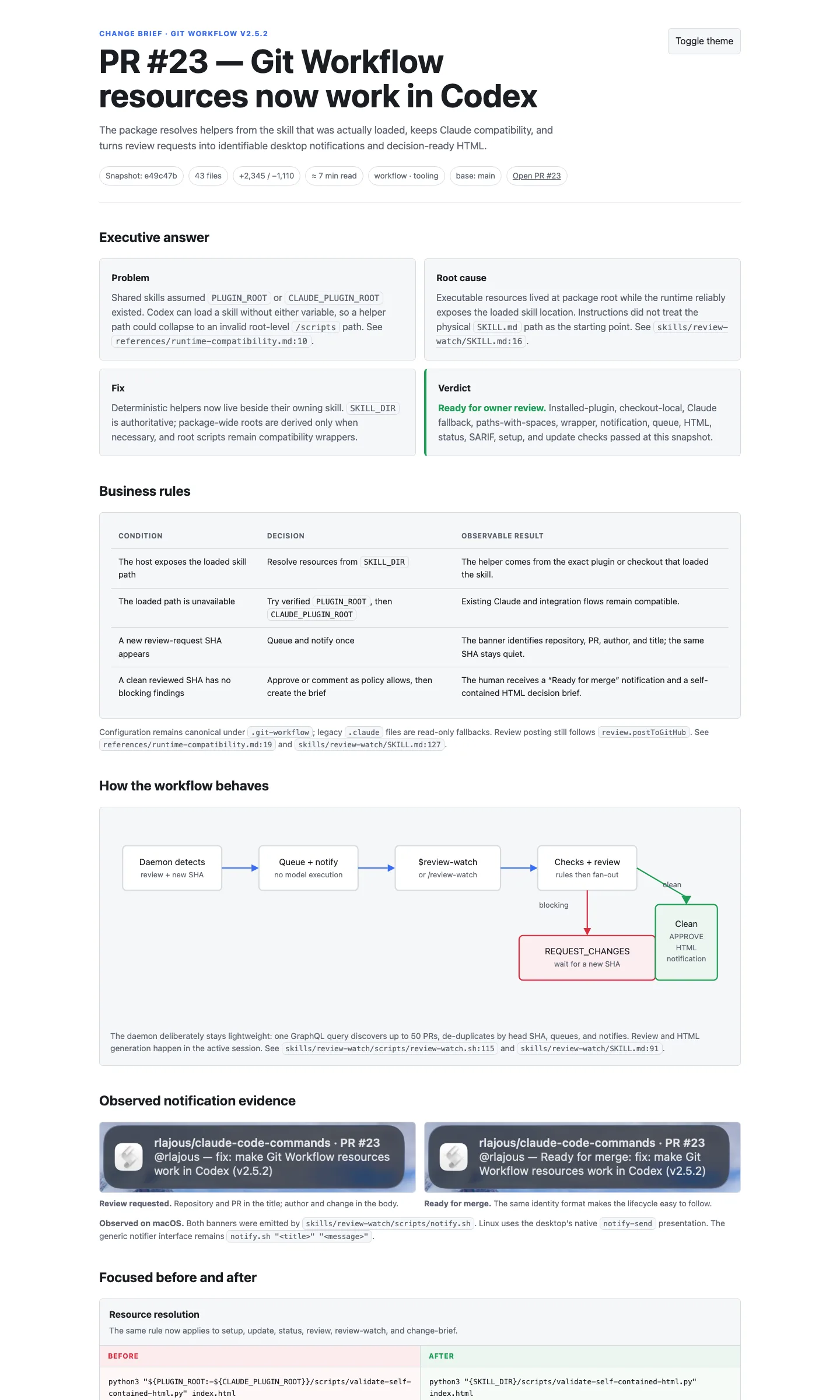
The example includes a business-rule table, an accessible inline SVG flow, real macOS notification evidence, focused before/after code, delivery risks, rollback, and verification results.
Generate a brief
Section titled “Generate a brief”Pass a PR number or URL, or omit it to use the current branch’s open PR:
/change-brief 42                                      # Claude Code/change-brief https://github.com/owner/repo/pull/42   # Claude Code
$change-brief 42                                      # Codex$change-brief https://github.com/owner/repo/pull/42   # Codex
The default output is:
.git-workflow/change-brief/pr-42/index.htmlOpen that file directly in a browser. It has no companion asset directory and can be copied or deleted as one unit.
What the reader gets
Section titled “What the reader gets”The primary reading path targets 6–8 minutes and is capped at 10 minutes:
- Executive answer: what changed, who is affected, why it matters, and the current verdict.
- Problem and root cause: the broken behavior and the concrete implementation reason.
- Business logic: actor, trigger, inputs, decisions, state changes, failures, and invariants.
- Fix and flow: how the new path reaches the observable result.
- Evidence: only the screenshots, HTTP exchanges, tests, diagrams, and code comparisons needed to prove the change.
- Risk and delivery: compatibility, rollout, rollback, security/data impact, and open questions.
- Collapsed appendix: changed-file inventory and secondary implementation details.
Factual claims are anchored to PR metadata or file:line references. Runtime output is marked
Observed; examples derived from tests, schemas, or fixtures are marked Expected.
Evidence by change type
Section titled “Evidence by change type”| Change type | Evidence |
|---|---|
UI, web, or mobile | Real before/after screenshots at matching state and viewport. Mobile uses a representative simulator or device size. |
HTTP API | Copyable cURL request plus status and response body from a safe environment; otherwise a schema/test-derived exchange labeled Expected. |
Business logic or data | Decision table plus state, side-effect, failure, retry, idempotency, and rollback behavior when relevant. |
Workflow or infrastructure | Entry point → resolver → resource → observable-result diagram, configuration precedence, and diagnostic output. |
Documentation only | Rendered information architecture and source-accuracy evidence; no decorative runtime proof. |
A diagram is used only when at least three meaningful steps, components, states, or branches become clearer visually. Briefs use accessible inline SVG or semantic HTML/CSS, never a remote renderer. Primary evidence is limited to six items and supporting detail moves behind disclosure controls.
Screenshot and API safety
Section titled “Screenshot and API safety”- Screenshots must come from the real base/head application state; generated or mocked UI is never presented as implementation evidence.
- Creating temporary worktrees or isolated checkouts requires explicit approval because it changes repository state. Without approval, the brief uses existing evidence and records the gap.
- HTTP evidence uses local, test, or explicitly approved environments. Tokens, cookies, personal data, internal hosts, and secrets are redacted.
- Production mutations are never performed just to create evidence.
Self-contained security contract
Section titled “Self-contained security contract”Each brief contains its CSS, JavaScript, diagrams, and screenshot bytes inline. It makes zero automatic external requests:
- no CDN scripts or styles;
- no remote fonts, images, analytics, or diagram renderers;
- no fetch, XHR, WebSocket, EventSource, beacon, or scripted navigation;
- a restrictive CSP in
<head>with connections denied; - HTML escaping for every PR-controlled title, body, file path, issue, and diff string.
PR and issue links remain ordinary user-initiated links. Before completion, the skill-local parser validates resource attributes, CSS URLs, executable JavaScript, duplicate attributes, and effective CSP placement.
For package development, validate an artifact directly:
python3 skills/change-brief/scripts/validate-self-contained-html.py \ ".git-workflow/change-brief/pr-42/index.html"Configuration
Section titled “Configuration”changeBrief: outputDir: .git-workflow/change-briefchangeBrief.outputDir changes the base directory used both to write and report the artifact.
Configuration resolves from .git-workflow/config.yaml, then the legacy .claude/config.yaml
read-only fallback.
Review Watch integration
Section titled “Review Watch integration”When Review Watch finishes a clean PR, it runs the host-correct Change Brief
invocation and sends the ready-for-merge notification. A self-authored PR or --comment-only may
post a GitHub COMMENT, but a clean result still produces the local brief.
If capture tooling, a runnable UI, or a safe API environment is unavailable, the brief keeps the gap visible and includes exact reproduction steps. It never fabricates observed evidence.
See Commands and Configuration for the complete package reference.