# Change Brief
> Generate a concise HTML decision brief with business logic, diagrams, screenshots, API evidence, risks, and verification.
Change Brief turns a pull request into one self-contained HTML decision document that a product or
engineering reader can understand in less than 10 minutes. It explains behavior and risk rather
than repeating the complete diff.
## Example
[Download the self-contained PR #23 example](/git-workflow/examples/pr-23/) and open it directly
in a browser. The public example is an English snapshot of PR #23 at commit `e49c47b`; it does not
change as later documentation commits are added to the PR.
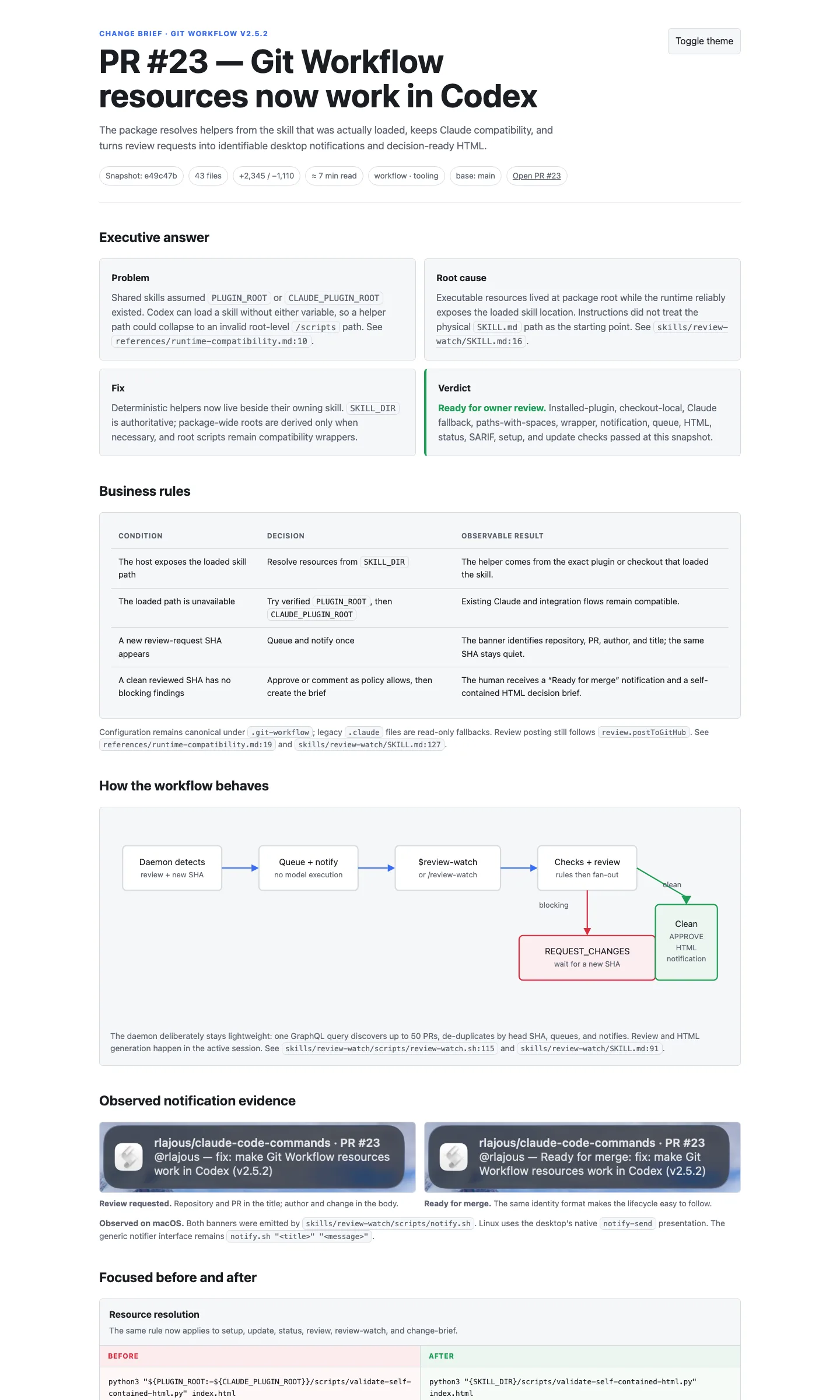 The example includes a business-rule table, an accessible inline SVG flow, real macOS notification
evidence, focused before/after code, delivery risks, rollback, and verification results.
## Generate a brief
Pass a PR number or URL, or omit it to use the current branch's open PR:
```text
/change-brief 42 # Claude Code
/change-brief https://github.com/owner/repo/pull/42 # Claude Code
$change-brief 42 # Codex
$change-brief https://github.com/owner/repo/pull/42 # Codex
```
The default output is:
```text
.git-workflow/change-brief/pr-42/index.html
```
Open that file directly in a browser. It has no companion asset directory and can be copied or
deleted as one unit.
## What the reader gets
The primary reading path targets 6–8 minutes and is capped at 10 minutes:
1. Executive answer: what changed, who is affected, why it matters, and the current verdict.
2. Problem and root cause: the broken behavior and the concrete implementation reason.
3. Business logic: actor, trigger, inputs, decisions, state changes, failures, and invariants.
4. Fix and flow: how the new path reaches the observable result.
5. Evidence: only the screenshots, HTTP exchanges, tests, diagrams, and code comparisons needed to
prove the change.
6. Risk and delivery: compatibility, rollout, rollback, security/data impact, and open questions.
7. Collapsed appendix: changed-file inventory and secondary implementation details.
Factual claims are anchored to PR metadata or `file:line` references. Runtime output is marked
`Observed`; examples derived from tests, schemas, or fixtures are marked `Expected`.
## Evidence by change type
| Change type | Evidence |
| --- | --- |
| UI, web, or mobile | Real before/after screenshots at matching state and viewport. Mobile uses a representative simulator or device size. |
| HTTP API | Copyable cURL request plus status and response body from a safe environment; otherwise a schema/test-derived exchange labeled `Expected`. |
| Business logic or data | Decision table plus state, side-effect, failure, retry, idempotency, and rollback behavior when relevant. |
| Workflow or infrastructure | Entry point → resolver → resource → observable-result diagram, configuration precedence, and diagnostic output. |
| Documentation only | Rendered information architecture and source-accuracy evidence; no decorative runtime proof. |
A diagram is used only when at least three meaningful steps, components, states, or branches become
clearer visually. Briefs use accessible inline SVG or semantic HTML/CSS, never a remote renderer.
Primary evidence is limited to six items and supporting detail moves behind disclosure controls.
## Screenshot and API safety
- Screenshots must come from the real base/head application state; generated or mocked UI is never
presented as implementation evidence.
- Creating temporary worktrees or isolated checkouts requires explicit approval because it changes
repository state. Without approval, the brief uses existing evidence and records the gap.
- HTTP evidence uses local, test, or explicitly approved environments. Tokens, cookies, personal
data, internal hosts, and secrets are redacted.
- Production mutations are never performed just to create evidence.
## Self-contained security contract
Each brief contains its CSS, JavaScript, diagrams, and screenshot bytes inline. It makes zero
automatic external requests:
- no CDN scripts or styles;
- no remote fonts, images, analytics, or diagram renderers;
- no fetch, XHR, WebSocket, EventSource, beacon, or scripted navigation;
- a restrictive CSP in `` with connections denied;
- HTML escaping for every PR-controlled title, body, file path, issue, and diff string.
PR and issue links remain ordinary user-initiated links. Before completion, the skill-local parser
validates resource attributes, CSS URLs, executable JavaScript, duplicate attributes, and effective
CSP placement.
For package development, validate an artifact directly:
```bash
python3 skills/change-brief/scripts/validate-self-contained-html.py \
".git-workflow/change-brief/pr-42/index.html"
```
## Configuration
```yaml
changeBrief:
outputDir: .git-workflow/change-brief
```
`changeBrief.outputDir` changes the base directory used both to write and report the artifact.
Configuration resolves from `.git-workflow/config.yaml`, then the legacy `.claude/config.yaml`
read-only fallback.
## Review Watch integration
When [Review Watch](/git-workflow/review-watch/) finishes a clean PR, it runs the host-correct Change Brief
invocation and sends the ready-for-merge notification. A self-authored PR or `--comment-only` may
post a GitHub `COMMENT`, but a clean result still produces the local brief.
If capture tooling, a runnable UI, or a safe API environment is unavailable, the brief keeps the
gap visible and includes exact reproduction steps. It never fabricates observed evidence.
See [Commands](/git-workflow/reference/commands/) and [Configuration](/git-workflow/reference/configuration/) for the complete package
reference.
The example includes a business-rule table, an accessible inline SVG flow, real macOS notification
evidence, focused before/after code, delivery risks, rollback, and verification results.
## Generate a brief
Pass a PR number or URL, or omit it to use the current branch's open PR:
```text
/change-brief 42 # Claude Code
/change-brief https://github.com/owner/repo/pull/42 # Claude Code
$change-brief 42 # Codex
$change-brief https://github.com/owner/repo/pull/42 # Codex
```
The default output is:
```text
.git-workflow/change-brief/pr-42/index.html
```
Open that file directly in a browser. It has no companion asset directory and can be copied or
deleted as one unit.
## What the reader gets
The primary reading path targets 6–8 minutes and is capped at 10 minutes:
1. Executive answer: what changed, who is affected, why it matters, and the current verdict.
2. Problem and root cause: the broken behavior and the concrete implementation reason.
3. Business logic: actor, trigger, inputs, decisions, state changes, failures, and invariants.
4. Fix and flow: how the new path reaches the observable result.
5. Evidence: only the screenshots, HTTP exchanges, tests, diagrams, and code comparisons needed to
prove the change.
6. Risk and delivery: compatibility, rollout, rollback, security/data impact, and open questions.
7. Collapsed appendix: changed-file inventory and secondary implementation details.
Factual claims are anchored to PR metadata or `file:line` references. Runtime output is marked
`Observed`; examples derived from tests, schemas, or fixtures are marked `Expected`.
## Evidence by change type
| Change type | Evidence |
| --- | --- |
| UI, web, or mobile | Real before/after screenshots at matching state and viewport. Mobile uses a representative simulator or device size. |
| HTTP API | Copyable cURL request plus status and response body from a safe environment; otherwise a schema/test-derived exchange labeled `Expected`. |
| Business logic or data | Decision table plus state, side-effect, failure, retry, idempotency, and rollback behavior when relevant. |
| Workflow or infrastructure | Entry point → resolver → resource → observable-result diagram, configuration precedence, and diagnostic output. |
| Documentation only | Rendered information architecture and source-accuracy evidence; no decorative runtime proof. |
A diagram is used only when at least three meaningful steps, components, states, or branches become
clearer visually. Briefs use accessible inline SVG or semantic HTML/CSS, never a remote renderer.
Primary evidence is limited to six items and supporting detail moves behind disclosure controls.
## Screenshot and API safety
- Screenshots must come from the real base/head application state; generated or mocked UI is never
presented as implementation evidence.
- Creating temporary worktrees or isolated checkouts requires explicit approval because it changes
repository state. Without approval, the brief uses existing evidence and records the gap.
- HTTP evidence uses local, test, or explicitly approved environments. Tokens, cookies, personal
data, internal hosts, and secrets are redacted.
- Production mutations are never performed just to create evidence.
## Self-contained security contract
Each brief contains its CSS, JavaScript, diagrams, and screenshot bytes inline. It makes zero
automatic external requests:
- no CDN scripts or styles;
- no remote fonts, images, analytics, or diagram renderers;
- no fetch, XHR, WebSocket, EventSource, beacon, or scripted navigation;
- a restrictive CSP in `` with connections denied;
- HTML escaping for every PR-controlled title, body, file path, issue, and diff string.
PR and issue links remain ordinary user-initiated links. Before completion, the skill-local parser
validates resource attributes, CSS URLs, executable JavaScript, duplicate attributes, and effective
CSP placement.
For package development, validate an artifact directly:
```bash
python3 skills/change-brief/scripts/validate-self-contained-html.py \
".git-workflow/change-brief/pr-42/index.html"
```
## Configuration
```yaml
changeBrief:
outputDir: .git-workflow/change-brief
```
`changeBrief.outputDir` changes the base directory used both to write and report the artifact.
Configuration resolves from `.git-workflow/config.yaml`, then the legacy `.claude/config.yaml`
read-only fallback.
## Review Watch integration
When [Review Watch](/git-workflow/review-watch/) finishes a clean PR, it runs the host-correct Change Brief
invocation and sends the ready-for-merge notification. A self-authored PR or `--comment-only` may
post a GitHub `COMMENT`, but a clean result still produces the local brief.
If capture tooling, a runnable UI, or a safe API environment is unavailable, the brief keeps the
gap visible and includes exact reproduction steps. It never fabricates observed evidence.
See [Commands](/git-workflow/reference/commands/) and [Configuration](/git-workflow/reference/configuration/) for the complete package
reference.